

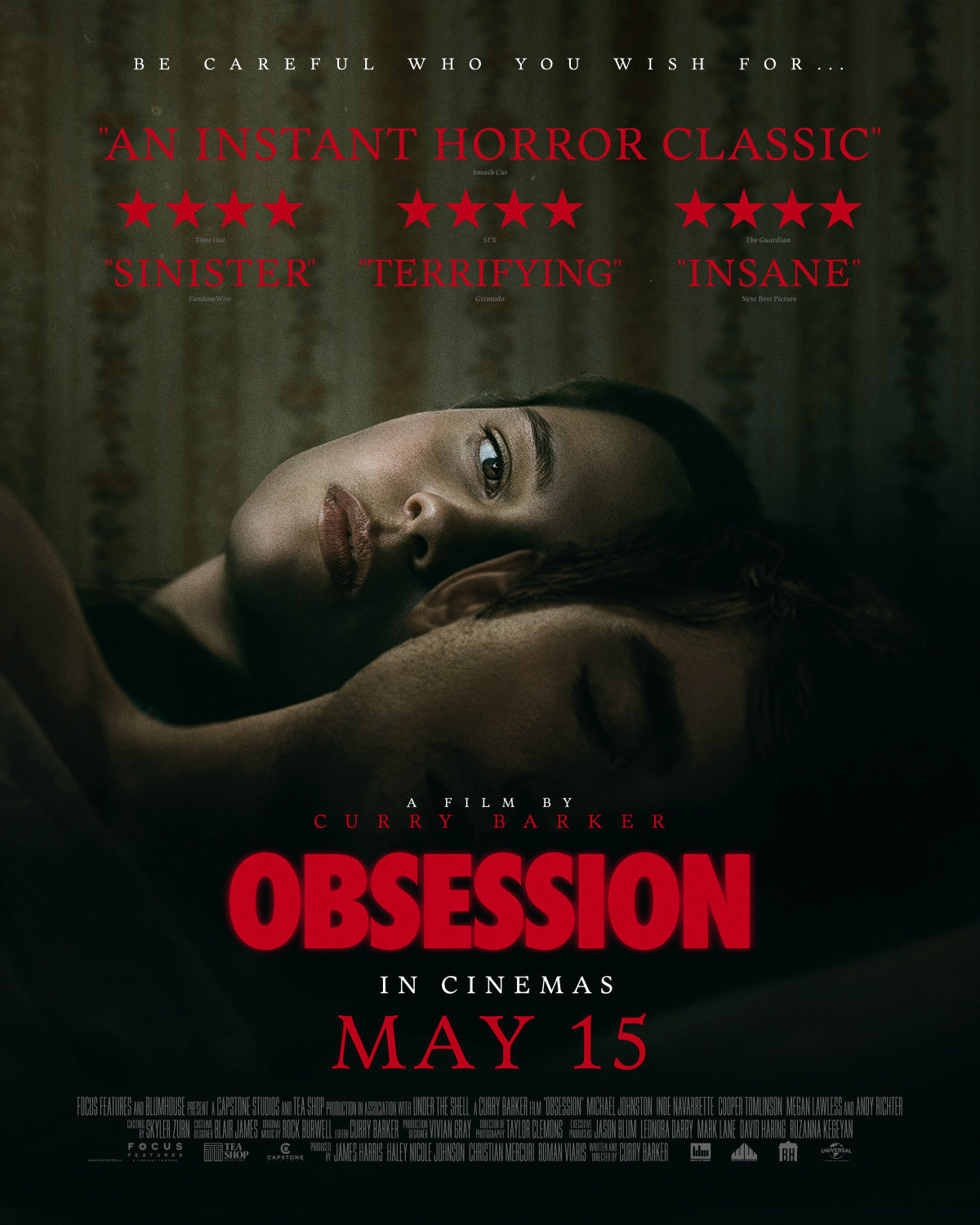
Is Obsession a Feminist Film?
TuneFM volunteer Hails sits down with Dr Bridgette Glover to discuss whether Curry Barker’s 2026 film Obsession counts as a feminist film and what that means.
Please note that this episode discusses some confronting topics like abuse, gender based violence, and assault. If these topics are distressing for you or bring up concerns for yourself or a loved one, please reach out to support on Lifeline 13 11 14, or 1800 RESPECT.
By Hails Trudgeon
Curry Barker’s 2026 film, Obsession, exposes deep-rooted societal fears surrounding rape culture and misogyny. It has been praised for being a feminist film, as it exposes a form of misogyny that can often be hidden in plain sight and perpetrated by the men you would least expect.
The film follows the character Bear (played by Michael Johnston), who is in love with his friend Nikki (played by Inde Navarrette). As Nikki does not seem to reciprocate his feelings, Bear makes a wish on a One Wish Willow, hoping Nikki will fall in love with him. The wish seems to work instantly, and Bear finally gets what he has been hoping for, but at what cost?
Bear is the manifestation of rape culture and misogyny, representing insecurity, coerciveness and cowardice – an incel. The word ‘incel’ is a colloquial term that stems from the phrase “Involuntarily Celibate”. This film comments on the concept of incels who dominate online forums. In this context, an incel is a man who may have experienced dating rejection and, as a result, perpetrates online hate, violence or abuse towards women. We see this in Bear from the beginning of the movie: when he feels rejected by Nikki, he refers to her as “Freaky Nikki”, knowing it will hurt her feelings. When that doesn’t work in his favour, he decides to make a wish. He wishes that she will love him as if he has a right for her to belong to him. This wish sets up a pattern of Bear taking away Nikki’s autonomy and humanity.
Bear is a haunting villain in this story because he is framed as the “Nice Guy”. He is terrifying because he could be your colleague, best friend, or neighbour. When Bear is framed alongside his more masculine and player friend, Ian (played by Cooper Tomlinson), we are shown two forms of misogyny. Ian’s form of misogyny is more overt, loud and jerk-like, while Bear’s is more secretive, coercive and insecure. The progression of Bear’s abuse of Nikki throughout the film exposes his form of misogyny as extremely dangerous. We see this at the start of the film, when Bear’s friend group of Sarah (Played by Megan Lawless), Nikki and Ian are ending their trivia night. Nikki asks Bear for money and says she’ll pay him back, and then gives the money to an unhoused man outside the pub. The contrast between Ian’s and Bear’s reactions is to make them more likeable. Bear looks on romantically at Nikki as if in awe of her, while Ian makes fun of her for giving the money. As time goes on, however, and Nikki is under control of Bear’s wish, we see Bear’s lack of care for Niki. When she hits herself in the head with a beer bottle, Ian is the one yelling at Bear and begging him to take her to the hospital, while Bear sits there, staring into space.
By far the most horrifying scene was not the gruesome way characters were killed; it is when Nikki – the real Nikki – breaks through while lying in bed and begs Bear to kill her. Nikki is clearly suffering, and Bear’s first response, rather than care, is to ask, “What is so bad about being with me?” He mirrors real-world incel culture here by victimising himself in a situation where he is the perpetrator. He then walks into the darkness after Nikki replies with “I’ve never been with you Bear,”. In that moment, Barker was showing us the maliciousness that underpins incel culture and Bear’s misogyny.
The ending of Obsession is discussed in more detail in my interview with Dr Bridgette Glover, if you want to hear more analysis of this. My final thoughts on Obsession is a Feminist film in the ways it exposes the genuine fears and horrors surrounding incel culture that we currently face.